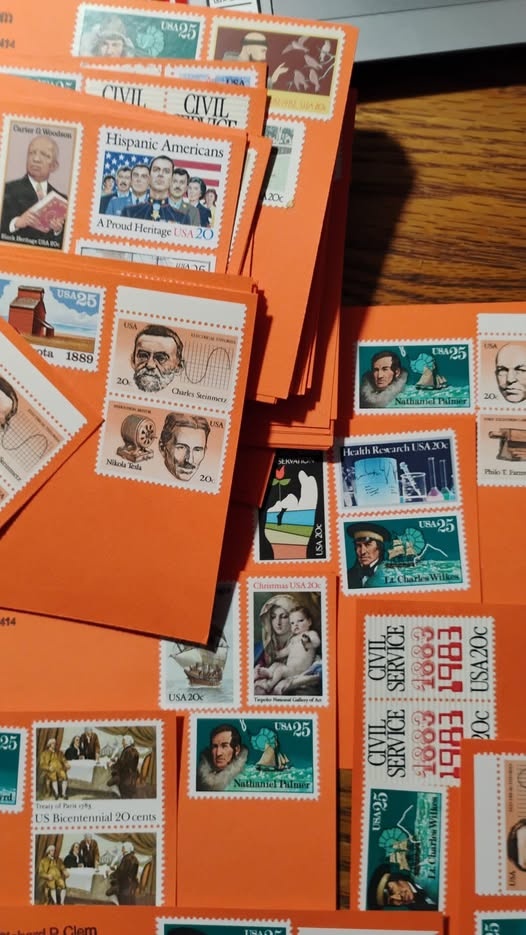
 When sending out direct mail or postcards for advertising, postage adds up fast. While most mailers simply print a meter strip or stick on standard modern stamps, there is an old-school postal secret that saves real money while making outgoing mail virtually impossible to ignore: buying vintage discount postage on eBay.
Shown above is a batch of postcards I recently mailed out for one of my Continuing Legal Education programs. One option would be to adorn each one with a mundane 65 cent stamp from the post office. Instead, I saved a little money and made the cards stand out in the morning mail with vintage stamps.
Starting in the 1940’s, many Americans decided that sheets of stamps would make a good investment. When a new issue came out, they bought a sheet and stashed it away, confident that it would finance their retirement. Unfortunately, a lot of people had the same idea. But more importantly, stamp collecting isn’t as popular as it was back in the day. So when it came time for them (or more likely, their heirs) to cash in the investment, they discovered that they hadn’t appreciated.
Fortunately, any U.S. stamp issued since the Civil War is still valid for postage, so they do have some value. But it’s generally less than the face value of the stamp, especially for small denominations. If you want to mail a letter with 82 cents postage, it’s hard to squeeze in enough one cent stamps to cover the new rate. So stamp dealers will buy them, but for significantly less than face value. Then, those dealers sell them on eBay as bulk postage.
In my case, I needed to mail a hundred postcards. So I purchased a hundred twenty-five cent stamps, and two hundred twenties. So each card got the required 65 cents with only three stamps. With a bit of creative placement, they fit easily on the card. And when the recipient gets the morning mail, it probably stands out just a little bit more than the other junk mail.
Warning: The Flood of Chinese Counterfeit “Forever” Stamps
When browsing eBay for cheap postage, you must know what you are looking at—because the marketplace is infested with illegal, counterfeit stamps. They’re particular prevalent on Facebook Marketplace, and I think the Postal Inspectors ought to execute a search warrant at Meta headquarters to get their attention.
If you search for “Forever stamps bulk” and see rolls of 100 or 1,000 current Forever stamps sold at 50% to 70% off face value (e.g., $30 for a roll with an $80+ face value) from accounts with little philatelic feedback or generic inventory, these are almost certainly counterfeit stamps manufactured overseas in China.
The United States Postal Inspection Service has seized tens of millions of fake Forever stamps entering the country. The counterfeiters produce high-resolution copies on peel-and-stick backing that look deceptively close to authentic stamps at a glance.
Modern USPS optical scanners and sorting machinery are equipped to detect counterfeit paper, ink formulations, and missing phosphor tagging. Sometimes people get away with using counterfeits, but if you do get caught, you run the risk of having your mail confiscated and destroyed, or criminal penalties.
Real Vintage Postage vs. Chinese Fakes: How to Spot the Difference
• Denominations: Authentic vintage discount postage features specific historic face values (e.g., 20¢, 25¢, 29¢, 32¢, 37¢). Counterfeits are almost always modern “Forever” stamps or current coil rolls.
• Gum Type: Most vintage stamps have traditional water-activated gum (lick-and-stick) or early self-adhesives on original backing sheets. Fakes are cheap peel-and-stick rolls with simulated microprinting.
Legitimate postage comes from reputable philatelic dealers with decades of stamp feedback and membership in organizations like the APS. Counterfeits come from fly-by-night accounts, gadget drop-shippers, or unvetted storefronts.
Counterfeiters do not forge 1983 Nikola Tesla 20¢ stamps or 1989 North Dakota 25¢ commemoratives. The profit margins are non-existent, and the water-activated engraved paper from 40 years ago cannot be cheaply faked at scale. When you buy sheets of vintage 20-cent stamps, you are getting genuine U.S. government postage.
I bought my stamps from Henry Gitner Philatelists, a reputable dealer in New York. If you need to buy stamps for your next batch of letters (82 cents each), one possibility is to buy packs of 25-cent stamps along with a pack of 32-cent stamps. The discount price for two 25-cent stamps and one 32-cent stamp works out to about 47 cents, and shipping is included. If those combinations are unavailable, you can search that seller’s listings for other combos that add up to 82 cents.
Back in the day, we licked stamps and envelopes, and lived to talk about it. On the other hand, if you have a lot of items to mail, licking 100 or 200 water-activated stamps gets old fast. A simple envelope moistener makes quick work of assembly.

Some links on this site are affiliate links, meaning that this site earns a small commission if you make a purchase after using the link.

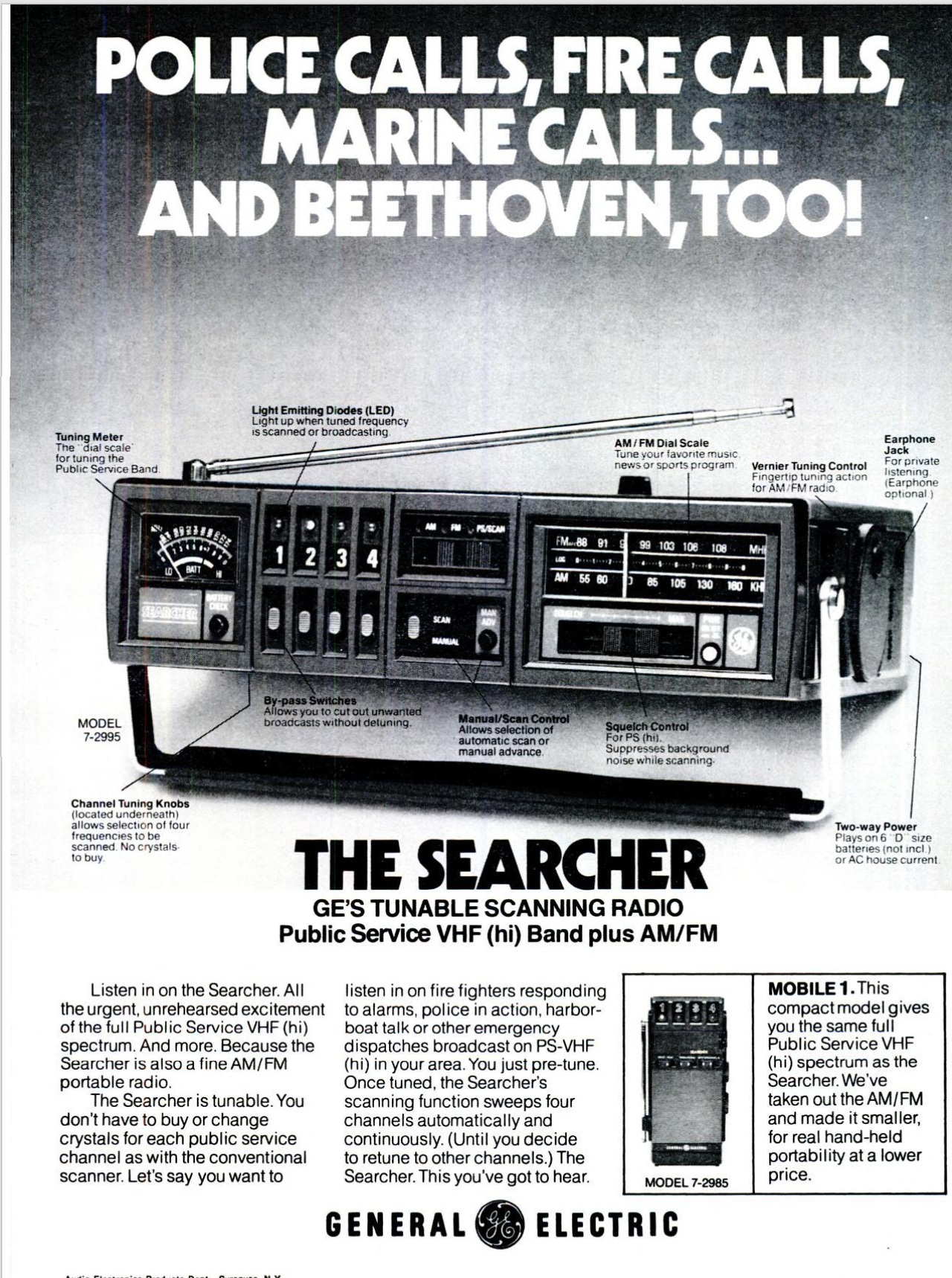 Fifty years ago this month, the October 1976 issue of Field and Stream carried an ad for this interesting radio receiver, which undoubtedly appealed to the avid outdoorsman.